
Life Sciences

About this Course
The Level 3 Diploma in Life Sciences – An NCFE Customised Qualification – is designed to help students get ready for further study in life sciences-related subjects. It enables learners to grasp key concepts of science and acquire skills such as critical thinking, research, and problem-solving. Students learn through practical activities and interactive lessons, which makes learning easier and more engaging. This qualification is also useful for students who want to build their careers in fields such as healthcare, nursing, or physiotherapy, among others.

Entry Requirements
01
IGCSE: Minimum grades of C's in Biology, Chemistry, and either Physics or Mathematics (old format)
02
IGCSE: Minimum point of 4's in Biology, Chemistry, and either Physics or Mathematics (new format)
03
American Curriculum - Minimum overall score of 70% in Biology, Chemistry, and either Physics or Mathematics in Grade 12
04
CBSE Curriculum - Minimum of 70% in Biology, Chemistry, and either Physics or Mathematics in Grade 12
05
Choueifat Curriculum - Minimum pass in Biology, Chemistry, and either Physics or Mathematics in Grade 12
06
Additional English language qualifications/tests may apply where the medium of teaching is not English.
07
Applicants must be at least 16 years old.
Course Outline
The program covers the following mandatory courses:
Atoms, Molecules, and Reactions
The course teaches the fundamentals of physical chemistry, so that students learn to account for and predict changes of chemical or biochemical state in terms of the constituents of matter and the energy changes they undergo. The course emphasizes problem solving skills and fundamental laws. Chemical principles will be illustrated with examples from life and health sciences, and students will be encouraged to find and discuss further applications.
Cells and Cellular Processes
This course provides a solid foundation for the study of biomedical phenomena and the conditions for cellular life and health. Beginning with the constituents of living things, the course explores the way that molecules and energy interact to produce compartmentalised structures that regulate and reproduce themselves. A special topic on thalassemia will illustrate the way that sub-microscopic components of cells exert their effects across human societies.
Measurements in Life Sciences
Students will learn how biology and health are described and investigated by physical approaches, since living systems have no special laws of their own. They will approach physical concepts through examples drawn from biological scenarios. These studies in physics will be underpinned by workshops, where students will become proficient in mathematical operations and thinking that will be required throughout their academic and professional lives. Finally, students will learn the basics of computing and apply them to a simple biological problem or scenario.
Medicine, Disease, and Society
The course introduces students to the social and historical context of health and healthcare, including contemporary problems and dilemmas, and possible future developments. Students will consider their own reasons for aspiring to work in healthcare, and will acquire tools for discussing and evaluating claims about health, disease, and treatment. In the course of this, they will develop their communicative competence and confidence, and become familiar with norms of academic work. In the course of activities and formal assessments, students will develop their own insights into learning style and revision; planning assignments; finding, selecting, and using sources; reading and note-taking strategies, class participation and teamwork; and most importantly, communicating and showing their learning.
Tissues, Systems, and Regulations
This course builds on the work of the Cells and Cellular Processes course to explain system-level phenomena in the life sciences. Students will study the principal physiological systems in mammals. Students are expected to apply physiological principles and mechanistic insights to explain the response of living systems to perturbations, including disease states.
Organic and Biological Chemistry
The course surveys the periodic table and organic chemistry, with an emphasis on principles (of atomic structure, of electron movements) that develop students’ skills in chemical problem solving. Functional groups will be studied in the context of reaction mechanisms (free radicals, eliminations, additions, substitutions) and function. Students are encouraged to explore biomedical applications of group chemistry, organic structure, and mechanisms.
Investigations in Life Sciences
This course prepares students to pursue and present their own work at a level appropriate to higher education. They will select a topic of interest, in negotiation with a supervisor, generate their own findings, and present the results in formats adapted to different audiences.
Course Outline
The program covers the following mandatory courses:
Atoms, Molecules, and Reactions
The course teaches the fundamentals of physical chemistry, so that students learn to account for and predict changes of chemical or biochemical state in terms of the constituents of matter and the energy changes they undergo. The course emphasizes problem solving skills and fundamental laws. Chemical principles will be illustrated with examples from life and health sciences, and students will be encouraged to find and discuss further applications.
Cells and Cellular Processes
This course provides a solid foundation for the study of biomedical phenomena and the conditions for cellular life and health. Beginning with the constituents of living things, the course explores the way that molecules and energy interact to produce compartmentalised structures that regulate and reproduce themselves. A special topic on thalassemia will illustrate the way that sub-microscopic components of cells exert their effects across human societies.
Measurements in Life Sciences
Students will learn how biology and health are described and investigated by physical approaches, since living systems have no special laws of their own. They will approach physical concepts through examples drawn from biological scenarios. These studies in physics will be underpinned by workshops, where students will become proficient in mathematical operations and thinking that will be required throughout their academic and professional lives. Finally, students will learn the basics of computing and apply them to a simple biological problem or scenario.
Medicine, Disease, and Society
The course introduces students to the social and historical context of health and healthcare, including contemporary problems and dilemmas, and possible future developments. Students will consider their own reasons for aspiring to work in healthcare, and will acquire tools for discussing and evaluating claims about health, disease, and treatment. In the course of this, they will develop their communicative competence and confidence, and become familiar with norms of academic work. In the course of activities and formal assessments, students will develop their own insights into learning style and revision; planning assignments; finding, selecting, and using sources; reading and note-taking strategies, class participation and teamwork; and most importantly, communicating and showing their learning.
Tissues, Systems, and Regulations
This course builds on the work of the Cells and Cellular Processes course to explain system-level phenomena in the life sciences. Students will study the principal physiological systems in mammals. Students are expected to apply physiological principles and mechanistic insights to explain the response of living systems to perturbations, including disease states.
Organic and Biological Chemistry
The course surveys the periodic table and organic chemistry, with an emphasis on principles (of atomic structure, of electron movements) that develop students’ skills in chemical problem solving. Functional groups will be studied in the context of reaction mechanisms (free radicals, eliminations, additions, substitutions) and function. Students are encouraged to explore biomedical applications of group chemistry, organic structure, and mechanisms.
Investigations in Life Sciences
This course prepares students to pursue and present their own work at a level appropriate to higher education. They will select a topic of interest, in negotiation with a supervisor, generate their own findings, and present the results in formats adapted to different audiences.
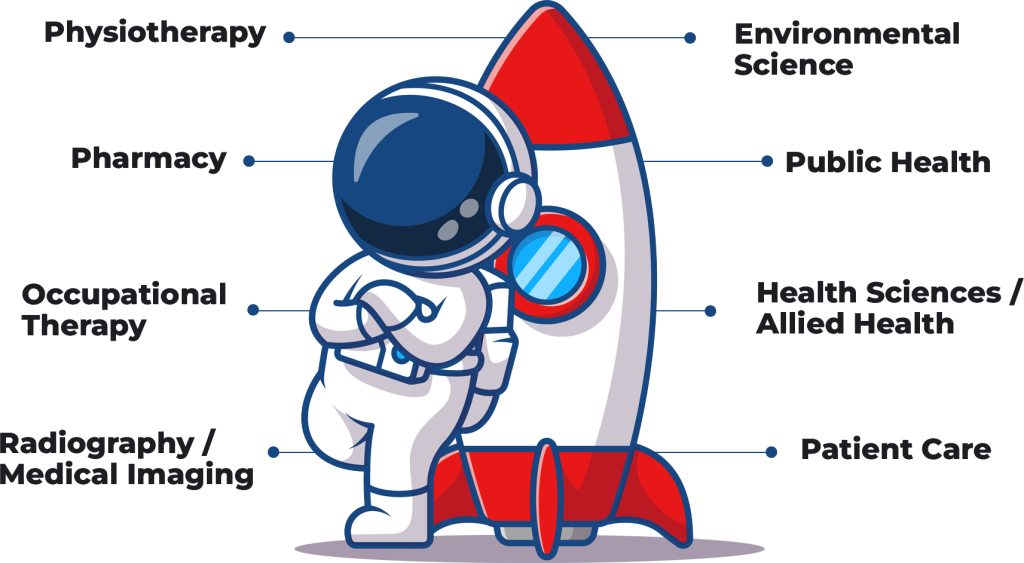
Post Qualification Routes
General Information
Duration
9/12 Months

Subject
Life Sciences
Hours
1,020 Guided Learning Hours
Intakes
January, April, June and September
Fees
AED 86,100 (including VAT)
Who is this course for?
It’s ideal for students preparing for further study in life sciences and for those interested in careers like healthcare, nursing, or physiotherapy.
What will I be able to do after completing this qualification?
You’ll be prepared for post-qualification routes in life sciences and develop key skills like research, critical thinking, and problem-solving.
Is the course more theory-based or practical?
It includes both, with a strong focus on practical activities, lab work, and interactive lessons to make learning more engaging.